• home
  • Korea Arbitration Library Search
  • Enforcement of Arbitral Awards in Korea

Enforcement of Arbitral Awards in Korea

  1. Enforcement of Arbitral Awards in Korea

    1. pdf
    1. Overview of Domestic Arbitral Awards

    2. Court Procedures for Enforcement of Domestic Arbitral Awards

    3. Compulsory Enforcement Proceedings

    4. Reference Material

    • 1. Overview of Domestic Arbitral Awards

      • Understanding of Domestic Arbitral Awards
        1. 1.
          Arbitration refers to a procedure agreed upon by the parties to resolve disputes involving property rights, as well as disputes involving non-property rights, that may be settled by the parties through an arbitral tribunal’s award rather than through court proceedings (Article 3(1) of the Arbitration Act).
        2. 2.
          Domestic arbitration refers to arbitration between parties whose principal place of business or domicile is in the Republic of Korea, and refers to arbitration that does not fall within the scope of international arbitration as defined by the International Arbitration Rules of the Korean Commercial Arbitration Board (“KCAB”) (Article 2(1) the KCAB Domestic Arbitration Rules). International arbitration refers to arbitration where at the time the arbitration agreement was made, one or more parties had their principal place of business outside the Republic of Korea, or where the seat of arbitration specified in the arbitration agreement is not located in the Republic of Korea (Article 2(3) of the KCAB International Arbitration Rules).
        3. 3.
          An arbitral award refers to the arbitral tribunal’s determination on the substance of the dispute and related matters to resolve the dispute that became the subject of arbitration through arbitral proceedings commenced on the basis of an arbitration agreement between the parties. An arbitral award that was rendered with a seat in the Republic of Korea is referred to as a domestic arbitral award, and an arbitral award rendered from abroad, meaning one whose seat of arbitration is outside the Republic of Korea, is referred to as a foreign arbitral award. It should be noted that even if the subject of arbitration concerns an international arbitration case, the arbitral award is a domestic arbitral award if the seat of arbitration is the Republic of Korea.
        4. 4.
          A domestic arbitral award has the same effect as a final court judgment between the parties, unless its recognition or enforcement is refused under Article 38 of the Arbitration Act (Article 35 of the Arbitration Act).
      • Recognition and Enforcement of Domestic Arbitral Awards
        1. 1.
          Even though an appropriate method of resolving the dispute between the parties has been presented by an arbitral award, in cases where the parties do not voluntarily comply with the decision set forth in the arbitral award, the entire process from the submission of the request for arbitration to the rendering of the award would be meaningless. Therefore, in such cases, the content of the arbitral award must be capable of compulsory enforcement. However, because arbitral proceedings, by nature, are established through the agreement between private parties, they cannot themselves have binding force and their enforcement ultimately requires the assistance of the State.
        2. 2.
          To respect the parties’ intention to autonomously resolve their dispute through arbitration without resorting to court proceedings and to promote various dispute resolution methods other than litigation, the State grants appropriate legal effect to arbitral awards and allows the use of State authority for their enforcement. However, because an arbitral award is fundamentally an adjudicatory act between private parties, for the State to recognize its legal effect, it retains the authority to examine whether the arbitral award is compatible with its legal order, including whether a lawful and valid arbitration agreement exists between the parties, whether the procedural rights of the parties were ensured throughout the arbitral proceedings, and whether the content of the arbitral award is consistent with public policy. Accordingly, while cooperating with the recognition and enforcement of arbitral awards, the State still sets minimum standards to examine whether the arbitral award is compatible with the legal order, and recognizes or enforces only those arbitral awards that meets these standards.
        3. 3.
          Recognition of an arbitral award refers to the acknowledgment of the legal effect of the arbitral tribunal’s award, whereas enforcement of an arbitral award refers to the court granting enforceability to the arbitral award, thereby allowing its compulsory enforcement.
        4. 4.
          Enforceability does not arise from the arbitral award alone; it is only through the procedure in which the court grants enforceability, that is, when the enforcement decision regarding the arbitral award becomes final, that the enforceability of the arbitral award can be recognized.
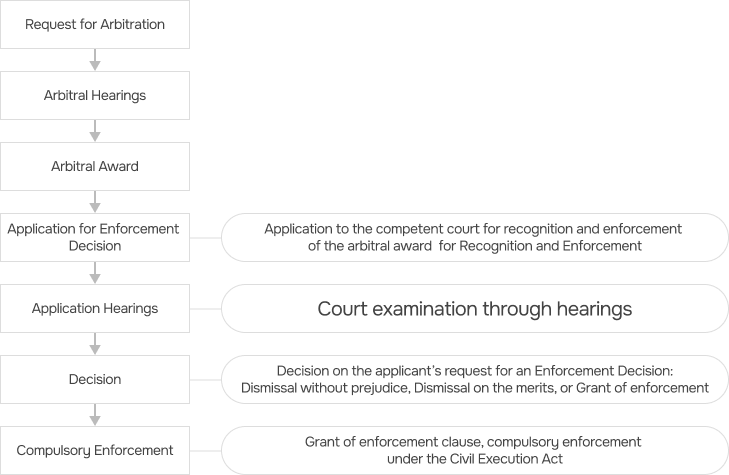
      • Summary of Arbitral Proceedings
        1. Enforcement of Arbitral Awards in Korea table 01
    • 2. Court Procedures for Enforcement of Domestic Arbitral Awards

      • Preparation of Application for Recognition and Enforcement of Arbitral Award
        1. 1.
          The party applying for recognition and enforcement of an arbitral award shall, in accordance with the Arbitration Act, submit to the competent court an application for the recognition and enforcement of the arbitral award together with the following documents (Article 37 of the Arbitration Act):
          1. (a)
            The arbitral award (an original or a copy. However, in case the arbitral award is written in a foreign language, a Korean translation shall be attached)
          2. (b)
            Materials evidencing the facts on which the application is based (originals or copies)
          3. (c)
            In case a legal representative files the application for recognition and enforcement of the arbitral award, documents proving the authority of such representative (a power of attorney).
        2. 2.
          In principle, an application for recognition and enforcement of an arbitral award shall state the following (see Standard Form for Application for Recognition and Enforcement of Arbitral Award within Article 3 of the Rule on Handling of Cases under the Arbitration Act):
          1. (a)
            Identification of the subject arbitral award
          2. (b)
            Name, address, and contact information of the party (in the case where the party is a legal entity, the corporate name, address, and contact information, together with the name and address of its representative)
          3. (c)
            In case where a legal representative exists, their name and address
          4. (d)
            Requested relief

            [Drafting Example]

            With respect to KCAB Arbitration Case No. [number] between the applicant and the respondent, the disposition set forth in Paragraph [number] of the dispositive part of the arbitral award rendered by the arbitral tribunal of the said arbitral institution on [date] and attached hereto, is hereby recognized, and enforcement based thereon is granted.

            The costs of this application shall be borne by the respondent.

          5. (e)
            Grounds for the application (the facts on which the application is based and the subject of the dispute)
          6. (f)
            Indication of the attached documents (including supporting materials submitted with the application)
          7. (g)
            Date of filing
          8. (h)
            Signature and seal of the applicant, with seals affixed across the pages
          9. (i)
            Indication of the court
        3. 3.
          The court that renders a decision on recognition and enforcement of an arbitral award shall be: (i) the court designated in the arbitration agreement; (ii) the court having jurisdiction over the seat of arbitration; (iii) the court having jurisdiction over the location of respondent’s assets; or (iv) the court having jurisdiction over the respondent’s address or place of business, or, in case such address or place of business is unknown, the respondent’s last-known address or place of business. The applicant may choose any appropriate court among the above.
        4. 4.
          At the filing of the application, the request shall, in principle, be filed either by directly visiting the competent court or through a postal service capable of verifying dispatch and receipt.
      • Filing of the Application
        1. 1.
          When filing the application for recognition and enforcement of the arbitral award to the court, revenue stamps shall be affixed and a certificate of payment of service fees shall also be attached (Articles 3, 18, and 11 of the Rule on Handling of Cases under the Arbitration Act).
        2. 2.
          In case of simultaneously applying for the recognition and enforcement of an arbitral award, revenue stamps in the amount of KRW 2,000 shall be affixed.
        3. 3.
          Service fees refer to the costs required for serving court documents on the parties or the opposing party. When submitting the application, service fees (postal costs) calculated according to the number of parties shall be paid to the service fee collection bank (generally a bank located within the building of premises of the court), and the certificate of payment of service fees issued by the bank shall subsequently be attached to the application. Upon filing the application for recognition and enforcement of the arbitral award, service fees equivalent to two deliveries per party shall be prepaid to the service fee collection bank, and the certificate of payment of service fees issued by the bank shall be attached to the application.

          [Example of Service Fee Calculation]

          In case of two parties:

          2 parties × KRW 5,200 × 2 deliveries

      • Application Hearings
        1. 1.
          When a party applies for recognition and enforcement of an arbitral award, the court shall designate a hearing date for argument or an examination session in which both parties may participate, and notify the parties thereof (Article 37(4) of the Arbitration Act). For the respondent, a duplicate of the application and an order to submit an answer shall be served (Articles 18 and 12(2) of the Rule on Handling of Cases under the Arbitration Act).
        2. 2.
          The court may, at its discretion, conduct a hearing for examination in lieu of holding an oral hearing. An examination refers to a procedure that supplements hearings based on written pleadings by giving the parties, interested persons, or other witnesses an opportunity to make individual statements in writing or orally by appropriate means without any particular method. It does not need to be held in an open courtroom, but may be conducted in an examination room. In case the court designates a hearing for examination, it may close the hearing immediately or separately designate and notify the parties of a deadline for its closure (Articles 18 and 12(3) of the Rule on Handling of Cases under the Arbitration Act).
      • Judgment on Application for Enforcement: Decision
        1. 1.
          Depending on the content of the judgment, a decision on an application for enforcement includes a decision dismissing the application without prejudice, a decision dismissing on the merits containing a declaration that enforcement of the arbitral award is not granted, or a decision granting the application (decision to enforce).
        2. A.
          Decision to Dismiss Without Prejudice
        3. 1.
          In case where there is a defect in procedural requirements, such as the jurisdiction of the competent court, party standing, party capacity, or subject matter eligibility, the court shall issue a decision dismissing the application without prejudice.
        4. B.
          Decision to Dismiss on the Merits
        5. 1.
          Where any grounds for refusing enforcement prescribed in Article 38 of the Arbitration Act exist, the court shall issue a decision dismissing the application.
        6. 2.
          The grounds for refusal under Article 38 of the Arbitration Act are as follows:
          1. (a)
            Where a party proves any of the facts under any items of Article 36 Paragraph(2)1 of the Arbitration Act:
            1. (i)
              incapacity of a party to the arbitration agreement or invalidity of the arbitration agreement (Item (a));
            2. (ii)
              infringement of the right to be heard in the arbitral proceedings (Item (b));
            3. (iii)
              the arbitral tribunal exceeding its authority or the scope of the arbitration agreement (Item (c)); or
            4. (iv)
              improper composition of the tribunal or procedural irregularities in the arbitral proceedings (Item (d)).
          2. (b)
            Where a party proves that the arbitral award has not yet become binding on a party.
          3. (c)
            Where a party proves that the arbitral award has been set aside by the court.
          4. (d)
            Where any grounds under Article 36 Paragraph(2)2 of the Arbitration Act exist:
        7. C.
          Decision in Favor of the Application (Enforcement Decision)
        8. 1.
          An enforcement decision of an arbitral award, that is, a decision granting the application for enforcement of the arbitral award, is issued when the requirements for filing a lawsuit are satisfied, a lawful and valid arbitral award exists, and no ground for refusal of enforcement is present. A standard form of the dispositive part is as follows:

          [Sample]

          With respect to Korean Commercial Arbitration Board (KCAB) Arbitration Case No. [number] between the claimant and the respondent, the arbitral award rendered by the KCAB arbitral tribunal on [date], as set forth in the Order of the arbitral award attached hereto, is hereby recognized, and enforcement based thereon is granted.

          The costs of the application shall be borne by the respondent.

        9. 2.
          Where an enforcement decision is rendered, Article 37(5) of the Arbitration Act provides that the reasoning of the decision shall be stated; provided, in the absence of a hearing, only a summary of the reasons may be stated.
      • Methods of Challenge
        1. 1.
          An immediate appeal can be made against a decision rendered on an application for enforcement (Article 37(6) of the Arbitration Act). Such immediate appeal does not have the effect of suspending the enforcement (main text of Article 37(7) of the Arbitration Act). However, until a decision on the immediate appeal is rendered, the appellate court (or the original court if the trial records remain there) may suspend the enforcement of the original decision or suspend all or part of the enforcement proceedings with or without providing security; or may order the provision of security and continue with the enforcement (proviso to Article 37(7) of the Arbitration Act). Such a decision shall not be subject to appeal (Article 37(8) of the Arbitration Act). This reflects the general premise that the court’s enforcement decision carries enforceability, and accordingly an immediate appeal does not have suspensive effect .
        2. 2.
          From the perspective of ensuring prompt resolution, the period for filing an immediate appeal is fixed at one week from the date on which the decision is notified (peremptory period) (see Article 444 of the Civil Procedure Act and Article 15 of the Civil Execution Act).
      • Compulsory Enforcement
        1. 1.
          For compulsory enforcement to be carried out, an enforcement title is required, and the arbitral award together with the enforcement decision constitutes such enforcement title.
        2. 2.
          Even where compulsory enforcement is carried out based on an enforcement decision for an arbitral award, an enforcement clause is required as in ordinary compulsory enforcement. Such enforcement clause is issued by a court clerk, etc. of the court of first instance that handled the application for the enforcement decision, by adding it at the bottom of the enforcement decision (Articles 28(2) and 29(1) of the Civil Execution Act). The court clerk, etc. determines whether to issue the enforcement clause based on the case record and the documents submitted by the creditor, without examining the parties, in the same manner as in other compulsory enforcement proceedings. Where the conditions precedent have not been satisfied, an enforcement clause is not issued; whereas in the case of an obligation that is not yet due, an enforcement clause may be issued, but compulsory enforcement cannot be commenced.
    • 3. Compulsory Enforcement Proceedings

      • Overview
        1. 1.
          A party that has obtained an enforcement decision for the arbitral award may proceed to enforcement on that basis. Thereafter, specific enforcement proceedings follow the relevant provisions of the Civil Execution Act, in the same manner as in ordinary enforcement proceedings.
        2. 2.
          A compulsory enforcement refers to a legal procedure through which the right to performance specified in the enforcement title is enforced with the assistance of the authority. Even when an arbitral award and a decision granting its enforcement have been rendered, if the debtor nevertheless fails to comply, the creditor may resort to compulsory enforcement proceedings.
        3. 3.
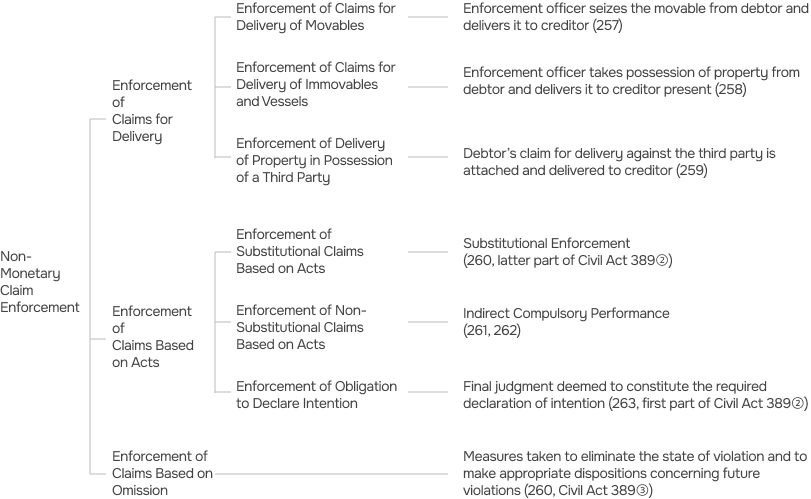
          When enforcement is pursued for a monetary claim, it is classified as compulsory enforcement against a monetary claim (monetary enforcement), while enforcement for nonmonetary rights is categorized as enforcement against a non-monetary claim (non-monetary enforcement). The Civil Execution Act provides extensive guidelines for monetary enforcement (Articles 61 to 256 of the Civil Execution Act), whereas there are only seven provisions concerning non-monetary enforcement (Articles 257 to 263).
        4. 4.
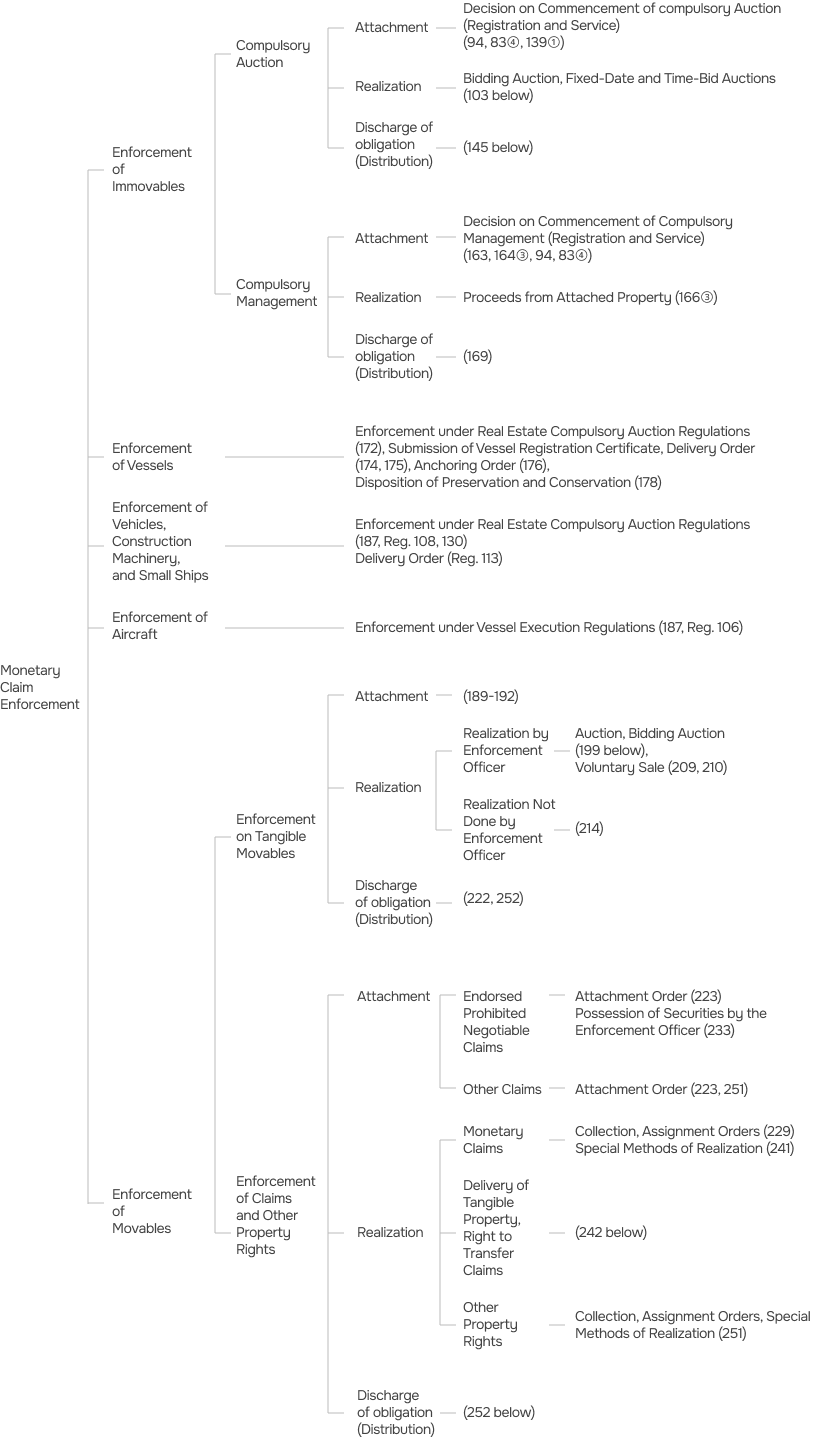
          Monetary enforcement is further categorized based on the type of property subject to enforcement: enforcement against immovable property; enforcement against vessels, vehicles, construction machinery, small ships, and aircraft; and enforcement against movable property. Enforcement against movable property is further subdivided into enforcement against tangible movables and enforcement against claims and other property rights.
        5. 5.
          The following is an overview of the compulsory enforcement proceedings (see the 2018 Civil Execution Act published by the Judicial Research and Training Institute):
        6. Enforcement of Arbitral Awards in Korea table 02
        7. Enforcement of Arbitral Awards in Korea table 03
      • Monetary Claim Enforcement against Immovable Property
        1. 1.
          Monetary claim enforcement against immovable property refers to compulsory enforcement carried out against immovable property owned by the debtor for the satisfaction of a monetary claim. The objects of such enforcement include land, buildings, and similar property.
        2. 2.
          Compulsory auction is initiated when a debtor fails to voluntarily perform the obligation under the enforcement title. The creditor files an application for auction with the district court having jurisdiction over the location of the immovable property, submitting the enforcement title with an enforcement clause, a certificate of service, a certificate of final judgment, and a certified copy of the real property registry, among other documents. The general procedure is as follows:
        3. A.
          Application for Compulsory Auction
        4. 1.
          An application shall be made in writing, and the following information shall be stated in the application (Article 80 of the Civil Execution Act):
          1. (a)
            Names and addresses of the creditor and the debtor;
          2. (b)
            Court of enforcement;
          3. (c)
            Description of the immovable property to be auctioned;
          4. (d)
            The specific claim giving rise to the compulsory auction and the claimed amount; and
          5. (e)
            The specific enforcement title on which enforcement may be carried out.
        5. 2.
          Here, the court of enforcement refers to the district court having jurisdiction over the location of the immovable property (Article 79 Paragraph (1) of the Civil Execution Act).
        6. 3.
          The applicant must submit an authentic copy of the enforcement title bearing enforceability, along with documents proving that the requirements for commencing compulsory enforcement have been satisfied, together with a certified copy of the real property registry or other documents that may substitute for it (Article 81 Paragraph (1)1 and Article 81 Paragraph (1)2 of the Civil Execution Act). In addition, the applicant is required to submit one copy of the payment receipt and the payment confirmation for registration tax (2/1,000 of the claimed amount) and local education tax (20/100 of the registration tax). The applicant must also prepay an estimated amount covering the costs of service, appraisal fees, property status investigation fees, newspaper publication fees, enforcement officer fees, and other related expenses.
        7. 4.
          If the applicant is a legal entity, a certificate proving the authority of its representative (e.g., a certified copy of the corporate registry) must be submitted. Where the application is made through an agent, a power of attorney proving the agent’s authority must be submitted.
        8. B.
          Seizure Procedure
        9. 1.
          When an application for compulsory auction is filed, the court issues a ruling to commence the auction, by which the immovable property concerned is seized (Article 83 Paragraph (1) of the Civil Execution Act). The court entrusts the competent registry office with making an entry of the ruling to commence the auction in the real estate registry, and the registrar makes the entry pursuant to such entrustment (Article 94 of the Civil Execution Act). An authentic copy of the ruling to commence the auction is served on the debtor.
        10. 2.
          If the application is deemed proper based on the matters stated in the application and the attached documents, the court issues a ruling to commence compulsory auction proceedings. The ruling to commence simultaneously orders the seizure of the immovable property concerned.
        11. 3.
          The seizure arising from the ruling to commence compulsory auction shall be effective when a ruling therefor has been served on the debtor or upon registration of the commencement of auction in the real property registry (Article 83 Paragraph (4) of the Civil Execution Act).
        12. C.
          Realization Procedure
        13. 1.
          The court shall order an enforcement officer to investigate the current status of the immovable property, occupational relations, the amount of rent or security deposit, and other relevant circumstances (Article 85 of the Civil Execution Act) and shall have an appraiser appraise the property, and determine the minimum sale price by taking account of such appraised price (Article 97 of the Civil Execution Act).
        14. 2.
          Once the above procedures are completed, the court shall fix the date of bidding (or the bidding period, in the case of period-bidding) and the date of decision on successful bidding, and make public notification thereof (Article 104 Paragraph (1) of the Civil Execution Act). On the date of bidding under a quoted auction or date auction, the enforcement officer, acting as an enforcement assistant, conducts the sale at a predetermined location, and designates the highest bidder and the second-highest bidder (Article 112 of the Civil Execution Act). If there is no bidder on the date of bidding, the court shall reasonably lower the minimum sale price, fix a new auction date, and conduct the process again (Article 119 of the Civil Execution Act).
        15. 3.
          At the date for the successful bidding, the court shall render a decision on whether to permit a sale after hearing the opinions of interested parties (Article 126 of the Civil Execution Act). Interested parties may file an immediate appeal against the decision on permission for sale (Article 129 of the Civil Execution Act).
        16. 4.
          Once the decision granting permission for sale becomes final and conclusive, the court sets a deadline for payment and orders the successful bidder to pay the purchase price (Article 142 of the Civil Execution Act). If the successful bidder fails to make payment by the specified deadline, and there is a next highest bidder, the court shall decide whether to permit sale to the next highest bidder (Article 137 Paragraph (1) of the Civil Execution Act). If there is no next highest bidder, the court shall order ex officio a resale of the immovable property (Article 138 of the Civil Execution Act). Once the decision granting permission for sale is rendered, the successful bidder may apply for an order for management of the auctioned immovable, and upon full payment, may apply for an order for delivery as well (Article 136 Paragraph (1) and Article 136 Paragraph (2) of the Civil Execution Act).
        17. D.
          Distribution Procedure
        18. 1.
          When the successful bidder has paid the full purchase price (once the sale price is paid), the court shall take the steps for distribution. When the proceeds of sale are insufficient to satisfy all creditors taking part in the distribution, the distribution shall be made according to the priority established by the Civil Act, Commercial Act, and other applicable laws (Article 145 of the Civil Execution Act).
      • Enforcement against Monetary Claims
        1. 1.
          Enforcement against monetary claims refers to compulsory enforcement carried out against the debtor’s assets consisting of monetary claims, that is, various claims through which the debtor may seek monetary payment from third-party debtors. Common types of claims subject to seizure include sale proceeds, loans, wages, lease deposits, payments for contract work, claims for return of deposits in court, telephone installation fees, bank deposit claims, and other similar monetary claims. The general procedure is as follows:
        2. A.
          Application for Seizure Order
        3. 1.
          Compulsory enforcement against monetary claims may be initiated upon the creditor’s written application for a seizure order. It is common to file the application for a seizure order together with an application for a collection order or an assignment order.
        4. 2.
          The application must state the following matters:
          1. (a)
            Request for relief;

            [Sample]

            The above claim of the debtor against the garnishee is hereby seized.

            The garnishee shall not make any payment to the debtor with respect to the above claim.

            The debtor shall not dispose of or receive payment for the above claim.

          2. (b)
            Details of the creditor, debtor, garnishee, and their representative(s);
          3. (c)
            Description of the enforceable claim;
          4. (d)
            Description of the enforcement title;
          5. (e)
            Type and amount of the claim to be seized; and
          6. (f)
            Grounds for application.
        5. 3.
          In addition to an authentic copy of any document bearing enforceability, an application for a seizure order must satisfy and substantiate the following: service of the enforcement title together with the enforcement clause and certified copies thereof; the arrival of the date for performance; the submission of the certificate of security provided and the service of a certified copy thereof; the fulfillment of any counter-obligations, etc.
        6. 4.
          Where an enforcement party or the garnishee is a legal entity, proof of the representative’s authority must be submitted; and where the application is made through an agent, a power of attorney must be attached.
        7. 5.
          The competent court shall be the district court having jurisdiction over the debtor’s general forum (Article 224 Paragraph (1) of the Civil Execution Act). In the absence of such a district court, the district court having jurisdiction over the garnishee’s general forum shall be the competent court (main text of Article 224 Paragraph (2) of the Civil Execution Act).
        8. B.
          Seizure Order
        9. 1.
          If, upon written examination, the court finds the application to be valid, it issues a seizure order (Article 223 of the Civil Execution Act). The seizure order is then provided ex officio to both the garnishee and the debtor (Article 227 Paragraph (2) of the Civil Execution Act).
        10. C.
          Realization Procedure
        11. 1.
          The realization procedure is carried out pursuant to a decision of the court in the form of a realization order (such as a collection order, assignment order, sale order, or transfer order) upon the creditor’s application.
        12. D.
          Distribution Procedure
        13. 1.
          Through a collection order or an assignment order, the creditor may receive the seized claim from the garnishee or have the claim against the garnishee directly transferred to the seizing party.
    • 4. Reference Material

      • Rule on the Handling of Cases Under the Arbitration Act
        1. CHAPTER I. GENERAL PROVISIONS Article 1 (Purpose)

          This Rule is intended to establish the procedures for handling cases under the jurisdiction of the courts pursuant to the Arbitration Act (hereinafter “Arbitration Case(s)”).

          Article 2 (Designation of Court Division Dedicated to Arbitration Cases)
          1. (1)
            The chief judge of each of the following courts shall designate a court division dedicated to handling Arbitration Cases:
            1. 1.
              Seoul High Court
            2. 2.
              Busan High Court
            3. 3.
              Seoul Central District Court
            4. 4.
              Daejeon District Court
            5. 5.
              Daegu District Court
            6. 6.
              Busan District Court
            7. 7.
              Gwangju District Court
          2. (2)
            Even where an Arbitration Case falls under the jurisdiction of a single-judge panel, an Arbitration Case may nonetheless be adjudicated by the court division dedicated to Arbitration Cases after undergoing a decision through the allocationadjustment procedure prescribed in the Rules on the Division of Duties and Case Assignment of Judges (Jaeil 2003-4).
          Article 3 (Application Form)

          Each court shall keep the following application forms at the customer service desk or inform that such forms are available on the website of the courts of the Republic of Korea:

          1. 1.
            Application for Appointment of Arbitrator(s) ( )
          2. 2.
            Application for Recognition of Interim Measures and Enforcement Decision ( )
          3. 3.
            Request for Court Assistance or (Cooperation) in Evidence Examination ( )
          4. 4.
            Application for Recognition and Enforcement of Arbitral Award ( )
          Article 4 (Authority of Representation)

          Where a party is represented by a legal representative, the court shall verify whether a document evidencing the authority of representation in the court proceedings, separate from that in the arbitral proceedings, has been submitted.

          Article 5 (Attachment of Translation)

          In case a party submits a document written in a foreign language, the court may order the party to supplement = the document by attaching its Korean translation.

          CHAPTER II. APPOINTMENT AND CHALLENGE OF ARBITRATOR(S) Article 6 (Receipt of Arbitration Cases Requiring Appointment of Arbitrator(s))

          Where an application for appointment of arbitrator(s) is filed, the case shall be registered as an arbitrator-appointment case, and the case record with a non-contentious case code and case number shall be created.

          Article 7 (Method of Appointment of Arbitrators)

          The court may directly appoint the arbitrator or designate an arbitral institution to appoint the arbitrator, taking into account the content of the party’s application, the nature of the case, and other relevant circumstances.

          Article 8 (Designation of Arbitral Institution for the Appointment of Arbitrator(s))

          Where the court makes a decision to designate an arbitral institution for the appointment of an arbitrator, it shallpromptly notify both the arbitral institution and the parties and transmit to the institution, the decision, the application for appointment of arbitrator, and any attachments submitted by the parties.

          Article 9 (Direct Appointment of Arbitrator(s))
          1. (1)
            Where the court directly appoints an arbitrator, it may request the parties or an arbitral institution to recommend candidates.
          2. (2)
            In such cases, the court may also request the submission of materials necessary to assess the suitability of the candidates as arbitrators.
          Article 10 (Application for Challenge of Arbitrator)

          Where an application for challenge of an arbitrator is filed, the court may order the applicant to submit in writing, within a designated period, the grounds for challenge and method of proof.

          CHAPTER III. RECOGNITION OR ENFORCEMENT OF INTERIM MEASURES Article 11 (Stamp Fees for Application for Recognition or Enforcement of Interim Measures)

          The stamp fees for an application for recognition or enforcement of interim measures shall be calculated mutatis mutandis in accordance with Article 9(5) of the Act on the Stamps Attached for Civil Litigation.

          Article 12 (Hearing of Application for Recognition or Enforcement of Interim Measures)
          1. (1)
            Upon receipt of an application for recognition or enforcement of interim measures, the court shall designate a date for a hearing for pleadings or a date for an examination at which both parties may participate and shall provide notice thereof. However, this shall not apply in circumstances where holding such a hearing would defeat the purpose of seeking recognition or enforcement.
          2. (2)
            In case of the main sentence of Paragraph 1, a copy of the application and an order to submit a written answer ( ) shall be served on the respondent.
          3. (3)
            Where the court holds an examination date, it may either close the examination immediately on that date or specify a separate deadline for the closure of the examination and provide notice thereof to the parties.
          CHAPTER IV. REQUEST FOR COURT ASSISTANCE OR COOPERATION IN EVIDENCE EXAMINATION Article 13 (Filing of Cases Requiring Request for Court Assistance or Cooperation in Evidence Examination)

          Where either a request for court assistance or a request for cooperation in evidence examination is filed, the case shall be registered respectively either as court assistance case or arbitration cooperation-request case, and the case record with a case code “Reo” and case number shall be created.

          Article 14 (Summons and Notifications)
          1. (1)
            In cases of a request for court assistance or cooperation in witness examination, a notice requiring the witness to appear ( , ) shall be served upon the witness.
          2. (2)
            Where the court designates a date for witness examination, inspection, or other evidentiary hearings , it shall notify such date and place to the arbitral tribunal.
          Article 15 (Conduct of Evidence Examination Hearings)
          1. (1)
            Evidence examination hearings shall be open to the public. However, the evidence examination hearings may be closed in cases where the arbitral tribunal requests non-disclosure by specifying the grounds therefor, or where there exist circumstances making public access inappropriate.
          2. (2)
            Where an arbitrator or a party to the Arbitration Case is present at the hearing date for witness examination, appraisal etc, the court may permit the arbitrator or a party to state opinions regarding the evidence examination or to question the witness or other persons.
          Article 16 (Delivery of Evidence Examination Results, etc.)
          1. (1)
            Upon completion of evidence examination under a request for court assistance, the court shall provide the arbitral tribunal a reply form ( ), with the certified copies of the witness-examination record, on-site inspection record, and any other records relating to the evidentiary proceedings.
          2. (2)
            Upon completion of cooperation pursuant to a request for court cooperation, the court shall provide the arbitral tribunal with a written statement setting out the results of the witness summons and service, the content of any orders addressed to document holders, and the results of service thereof, and other matters regarding the cooperation provided.
          Article 17 (Return of Request for Court Assistance or Request for Cooperation)

          Where any of the following grounds exist, the court may return any request made for court assistance or cooperation by issuing a return form ( ), specifying the reasons therefor:

          1. 1.
            The arbitral tribunal fails to submit materials sufficient to establish the purpose, substance, and necessity of the court assistance or cooperation in evidence examination, despite the court’s order to supplement;
          2. 2.
            The arbitral tribunal fails to pay in advance the expenses required for evidence examination, despite the court’s order to supplement; or
          3. 3.
            The evidence examination pursuant to a request for court assistance is impossible, or service or other actions required by a request for cooperation cannot be carried out.
          CHAPTER V. RECOGNITION OR ENFORCEMENT OF ARBITRAL AWARDS Article 18 (Processing of Applications for Recognition or Enforcement of Arbitral Awards)

          Articles 11, 12(2), and 12(3) shall apply mutatis mutandis to an application seeking recognition or enforcement of an arbitral award.

          ADDENDA Article 1 (Effective Date)

          This Rule shall enter into force on 11 December 2017.

          Article 2 (Transitional Measures)

          This Rule applies to all cases pending in any court at the time of their enactment. However, this Rule does not apply to cases filed before 30 November 2016.

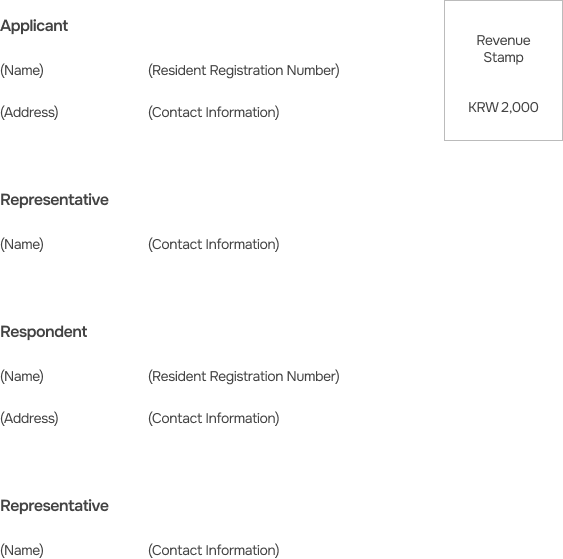
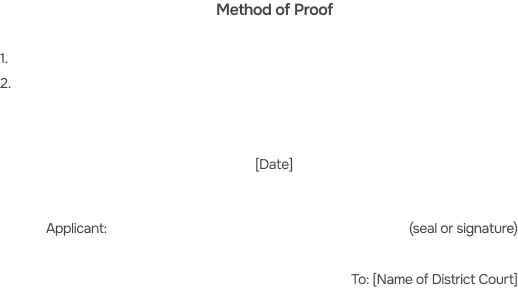
      • Application Form for Recognition and Enforcement of Arbitral Award [Electronic Form A2583]
        1. Application for Recognition and Enforcement of Arbitral Award Enforcement of Arbitral Awards in Korea table 04 Request for Relief

          I, the applicant, hereby request a decision as follows:

          1. 1.
            With respect to [name of arbitral institution] Arbitration Case No. [number] between the Applicant and the Respondent, the arbitral award rendered by the arbitral tribunal of the said arbitral institution on [date], as set forth in Paragraph [number] of the dispositive part of the arbitral award attached hereto, is hereby recognized, and compulsory enforcement based thereon is granted.
          2. 2.
            The costs of this application shall be borne by the Respondent.
          Grounds for Request Enforcement of Arbitral Awards in Korea table 05 Notes
          1. 1.
            Pursuant to Articles 37(1) and 37(2) of the Arbitration Act, when applying for a decision on both recognition and enforcement of an arbitral award simultaneously, a revenue stamp of KRW 2,000 shall be affixed.
          2. 2.
            The applicant shall provide, in the contact information section, a telephone number or mobile phone number (including fax number, email address etc) for prompt communication at any time.
          3. 3.
            Upon filing this application, service fees for two rounds per party shall be prepaid to the service-fee receiving bank.
          [Sample of Relief Sought in Similar Applications] (1) Application for Enforcement of Arbitral Award (Sample):
          1. 1.
            With respect to [name of arbitral institution] Arbitration Case No. [number] between the Applicant and the Respondent, the arbitral award rendered by the arbitral tribunal of the said arbitral institution on [date], as set forth the arbitral award attached hereto, is hereby recognized, and compulsory enforcement based thereon is granted.
          2. 2.
            The costs of this applicatoin shall be borne by the respondent.
          (2) Request for Recognition of Arbitral Award (Sample):
          1. 1.
            With respect to [name of arbitral institution] Arbitration Case No. [number] between the Applicant and the Respondent, the arbitral award rendered by the arbitral tribunal of the said arbitral institution on [date], as set forth in Paragraph [number] of the dispositive part of the arbitral award attached hereto, is hereby recognized.
          2. 2.
            The costs of this application shall be borne by the respondent.
          Notes

          Pursuant to Article 37(1) and 37(2) of the Arbitration Act, when applying only for an enforcement decision (or only for a recognition decision), a revenue stamp of KRW 1,000 shall be affixed.